
Friday, February 18, 2011
Mural Ideas of "Human and Scholarship" Mural
Herewith are the mural ideas of "Human and Scholarship" Mural:


Color Studies Presentation of "Human and Scholarship" Mural
Herewith are some of the Color Studies Presentation of "Human and Scholarship":


Color Schemes of "Human and Scholarship" Mural
The development of the color scheme for a mural to be produced in the SWARTS building (University of Pittsburgh at Bradford) requires that it should have all the characteristics typical of mural paining in public architectural spaces. The building is not only the home of the university administration, but also the location of the halls where numerous disciplines (19) are studied.
This fact itself suggested the color scheme formula, as was the case with the main idea of the mural design, presented last time.
Just as its composition consists of the three main geometrical shapes – carriers of the message –triangle, square and circle, the color scheme too should be equally fundamental.
A basic principle in the field of color theory, the only one of the same scope and significance, is the topic of the two types of color mixing – additive color mixing and subtractive color mixing.
I chose subtractive color mixing, not accidentally considered as the “element/territory/cosmos/universe of artists.”
Similarly to how the mixing of the three primary colors results in the endless diversity of spectrum colors and all other colors in nature visible to the human eye, the “mixing” (interaction) of thinking and creation results in the diversity of the human world created by art, science and technology, existing parallel to the world of nature and even attempting to surpass it.
The content of the social sciences and the humanities studied in SWARTS reflects the variety of people’s creation as if through the prism of a kaleidoscope, building layer upon layer during the process of learning in the form of numerous pieces of knowledge.


A basic characteristic of this type of color mixing is that colors are perceived as transparent filters layered one upon the other. On top comes the triangle (a symbol of thinking, which precedes the rest), followed by the square (the creation, the making), and the circle at the back (everything created).
I developed two versions of subtractive optical mixing, where the triangle and square swap colors – magenta and cyan blue, respectively, in which case the derivative (supplementary) colors are different as the result of placing them upon the lemon yellow circle.
The reason for this swap is based on the meanings of colors according to color symbolism, on the one hand, where thinking belongs with ethereal colors – light blue, and the activity of creation – with the warm, red color groups. Exactly the opposite takes place, if we adopt the color symbolism of gorintō, for example – the Japanese pagoda philosophy, expressing the five elements through the five basic geometrical forms, according to which the triangle is a symbol of fire, therefore colored in red.
The idea about how to place the human figures on top of these geometrical color “filters” is slightly different. I attempted several versions in which the two figures belong only to the color of the triangle, suggesting in this way that the making/creation is part of thinking.
The second series of options envisages for every figure to have the color of the geometric form to which it is assigned, thus suggesting that the making/creation and thinking, although related, are at the same time very different human activities.
The third series of color options is based on the same optical concept, but this time placed onto a white circle.
The last options represent pure color play – changing the color of the circle inside the background, according to the sequence of colors in the color wheel, moving clockwise, and the respective total change in all the other components in the two color formulas (with blue and red figures), based on the principles of complementary contrast. This kind of play aims to demonstrate just a small fraction of the infinite color possibilities of mural art.


Ideas for the "Human and Scholarship" Mural
This mural will showcase the diverse academic programs hosted in this unique academic building. To create a mural dedicated to the humanities and social sciences/the disciplines studied in the SWARTS building is a complex and responsible task. It is difficult to find an overall idea to connect their diversity, organize it and give meaning to it.
There is, however, such a collective image – that of man, who is at the same time the creator and consumer, i.e. the generating center and the absorbing periphery, the cause and effect of all human activities, which give significance to the existence of our human society on Earth.The following images are some of the initial ideas related to content, composition and color studies of this ongoing mural project.
Or saying in Latin: “Cogito ergo genero ergo sum” (I think, therefore I create, therefore I am).


I decide to approach this backwards - from the idea, the message.
The first idea that occurred to me was to place the student at the center of the mural – now a learner, but later a future scientist, researcher, creator or artist.
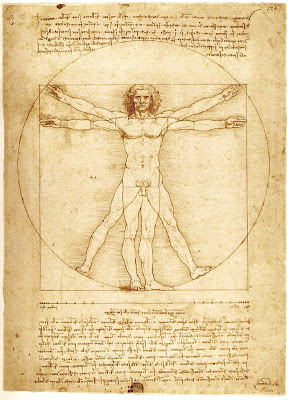
I remembered the famous Vitruvian Man by Leonardo and how he created, based on Vitruvius, the formula of the difference between the static and moving body, inscribing it into a square (= static position) and then into a circle (= movement).
So far, this has been the presentation of the Mini- Mural Project – a conceptual scheme for a classical, static, and single-faced mural.


The main characteristic of our dynamic time includes change, diversity, and the participation of everyone in the challenges and exceptional pleasure of the act of creation. Man is, in addition to everything else, a “homo ludens” (playing man).
Human beings have been the object of drawing since the dawn of mankind – what is it that can turn a concrete human figure into a symbol of humanity, the essence of being human? Or to put it in other words, what is the formula of “the human”?
It consists of man’s two major functions – to think and to create.
Thus I arrived at the “formula”: Thinks + Creates = Human (Being) (T + C = H)


I decide to approach this backwards - from the idea, the message.
The first idea that occurred to me was to place the student at the center of the mural – now a learner, but later a future scientist, researcher, creator or artist.
The ideal image and symbol of this idea is the famous statue of Kai, the Seated Scribe, in the Louvre. His ancient figure, frozen in a posture of eternal submissiveness, expectation and obedience, does not at all relate to my idea of the human being as creator today.
Another series of images, which occurred to me were the numerous statues and murals depicting Buddha and the Bodhisattvas. I like their extreme immersion into and concentration on their pursuit of oneness with the whole diversity of the Universe – the so-called state of “moksha”. However, this otherwise wonderful image too does not correspond to my perception of the contemporary active human being and creator.
I had to go back to the beginning in order to be able to go forward. And this always is the formal, compositional decision.
This was the source of my key idea – to create a geometric formula of the thinking and creating human being.
The equilateral triangle is the geometric equivalent of the break-through, undoing (literally “piercing through”) the status quo, because it is in fact a heavily stylized schematic image of the point of an arrow or a pointer, i.e. – the symbol of thought which aims at the achievement of a certain goal.
The square (the cube) is the emanation of creation, the origin, and the foundation stone laid first in the construction of, for example, temples, churches, and buildings in general, not accidentally referred to as “basic” and “fundamental.” Imagine the building blocks of the Egyptian pyramids, symbols of endurance and eternity.
They, of course, are inscribed into a circle, which seals off the world of man’s creation from the rest of the material world of nature and the environment. The circle is a symbol of the oneness of human existence which is nothing but “thinking (inventing), i.e. the setting, the choice, of a goal – to create, i.e. the achievement, the realization of that goal.”
Deciding on the postures of the man thinker and the man creator, inscribed into the geometric figures was not difficult at all. Everything came down to the interrelation: human hands versus head and their relative position in either one or the other state. There is, of course, a slight transformation in the legs.
But why a female figure you would ask?
On the surface, the idea seeks to achieve a certain rehabilitation of the woman in order to compensate for her status over the millennia, and to place her on the pedestal of the human being as thinker and creator, something unprecedented (at least in the field of mural painting).
In depth, however, the idea of this approach is to express how thinking and creation involve not only the mind, but feelings, a powerful emotion that runs deep, the emotion of the making, the creation, the generation of something out of nothing. Woman is the symbol of this incredible capacity – with her infinite love, patience and hard work she creates out of her own body not only physically self-sufficient human beings, but also personalities who feel, react and possess the ability to perceive and create.
The geometric figures intersect, the result of which will be numerous segments surrounding the man thinker and creator like a background, and which will contain the images symbolizing the content of all the disciplines/subjects studied in the building, and which you, the students, are going to seek out – this will be your contribution to this collective project.


However, there is a Maxi- Mural Project (a standard and innovative version of the project, respectively).
I am talking about the creation of a mural installation consisting of 16 square modules (the number of people in our group, including myself) based on the “puzzle” principle, the difference being that each of them will be mobile and spinning around its axis, but will also have an obverse and reverse side as with coins, and will be reversible, i.e. it will be visually active on both sides.
Thus the task is doubled but also incomparably more interesting.
The same geometric compositional structure will also be at the back, but with a male figure and the reverse color scheme for the face.
The entire composition may be kept as it is initially created – by swapping the “faces” only, but the modules could also be disassembled and reassembled into new compositions with a great number of new visual decisions.
Everyone can join in this act of co-authorship and play – students, faculty and guests of the University.
Collaborative Mural Project: Human & Scholarship
Introduction to "Human & Scholarship: Collaborative Mural Project at University of Pittsburgh at Bradford":
Acad. Prof. Oleg Gotchev, a current Bulgarian Fulbrighter, is leading a collaborative mural project at the University of Pittsburgh at Bradford (UPB) with 15 American students with diverse majors and years in the spring of 2011. The mural site is located in the central lobby of the Swarts Hall, a multi-academic teaching facility, at the UPB. The dimension of the mural wall is 212 cm height by 240 cm wide (6.95'H x 7.87'W).


Acad. Prof. Oleg Gotchev, a current Bulgarian Fulbrighter, is leading a collaborative mural project at the University of Pittsburgh at Bradford (UPB) with 15 American students with diverse majors and years in the spring of 2011. The mural site is located in the central lobby of the Swarts Hall, a multi-academic teaching facility, at the UPB. The dimension of the mural wall is 212 cm height by 240 cm wide (6.95'H x 7.87'W).


Art 0109 Mural Design in University of Pittsburgh at Bradford Spring 2011
Parallel with this the course offers cycle of lectures with the theme: Mural Painting in Contemporary Culture. This course provides American students with an introduction to the place and significance of murals in a globalizing world culture. Some new elements in the development of compositional thinking in contemporary art, the problems, themes and spiritual contents, which excite humanity and the ways they find a visual manifestation in murals are reviewed. Attention is paid to some new forms in mural art and its synthesis with architecture and the living environment, the problems of collective creativity and their solution in the creation and implementation of international artistic projects, the specificities of creative behavior and reaction in the situation of cultural integration are analyzed.
The content and its forms of manifestation in contemporary mural painting are subject of analysis and practical work. As part of world's contemporary culture, mural painting is in the process of globalization, which raises two major problems for the future of this millennial art: the first relates to the overall change in the value criterion – mural painting is offered a choice between durability and transience in a situation of continual change of values along with the change in the classic expressive and technical means, to make it competitive in relation to the all-consuming design and advertising; the second problem is the need for each culture to choose or balance between the national and the universal.
The themes of the lectures in this course are: new dynamic compositions; single-diagonal composition; triangular composition; new tradition – murals in public architecture: new “historicity” and political murals; murals in private/residential architecture. Тrompe l'oeil; mural pluralism – stylistic and thematic diversity, advertising murals, mobile murals, new synthesis; street art (post-graffiti); international projects – Agenda 21, Mural Global World Mural Campaign of Farbfieber and UNESCO, and collective interactive and other international mural projects – Mural by Mail, Martenitza para Mexico. All lectures are illustrated with numerous examples from the history of contemporary mural painting.
The content and its forms of manifestation in contemporary mural painting are subject of analysis and practical work. As part of world's contemporary culture, mural painting is in the process of globalization, which raises two major problems for the future of this millennial art: the first relates to the overall change in the value criterion – mural painting is offered a choice between durability and transience in a situation of continual change of values along with the change in the classic expressive and technical means, to make it competitive in relation to the all-consuming design and advertising; the second problem is the need for each culture to choose or balance between the national and the universal.
The themes of the lectures in this course are: new dynamic compositions; single-diagonal composition; triangular composition; new tradition – murals in public architecture: new “historicity” and political murals; murals in private/residential architecture. Тrompe l'oeil; mural pluralism – stylistic and thematic diversity, advertising murals, mobile murals, new synthesis; street art (post-graffiti); international projects – Agenda 21, Mural Global World Mural Campaign of Farbfieber and UNESCO, and collective interactive and other international mural projects – Mural by Mail, Martenitza para Mexico. All lectures are illustrated with numerous examples from the history of contemporary mural painting.
Wednesday, July 7, 2010
Announcement 35: More Mural Opening Ceremony Pictures
Thanks to the U.S. Embassy's photographer and staff, we have several more nice pictures of our mural opening ceremony in June 25, 2010.


Subscribe to:
Posts (Atom)